Tamiami Trail Through the Everglades: A 2026 Guide to Florida's Wildest Drive
There\u2019s a stretch of asphalt in South Florida where the outside world dissolves into a living, breathing tapestry woven by water and sawgrass. Driving the Tamiami Trail \u2013 officially U.S. 41 \u2013 is not simply a means to get from Miami to Naples. It\u2019s a slow-motion nature documentary playing out beyond the windshield, a place where the landscape itself feels like a gigantic, sun-soaked lung inhaling and exhaling with each turn of the tide. By 2026, more travelers are rediscovering this two-lane wonder as a sanctuary of slow travel, a contrast to the breakneck pace of Interstate 75.
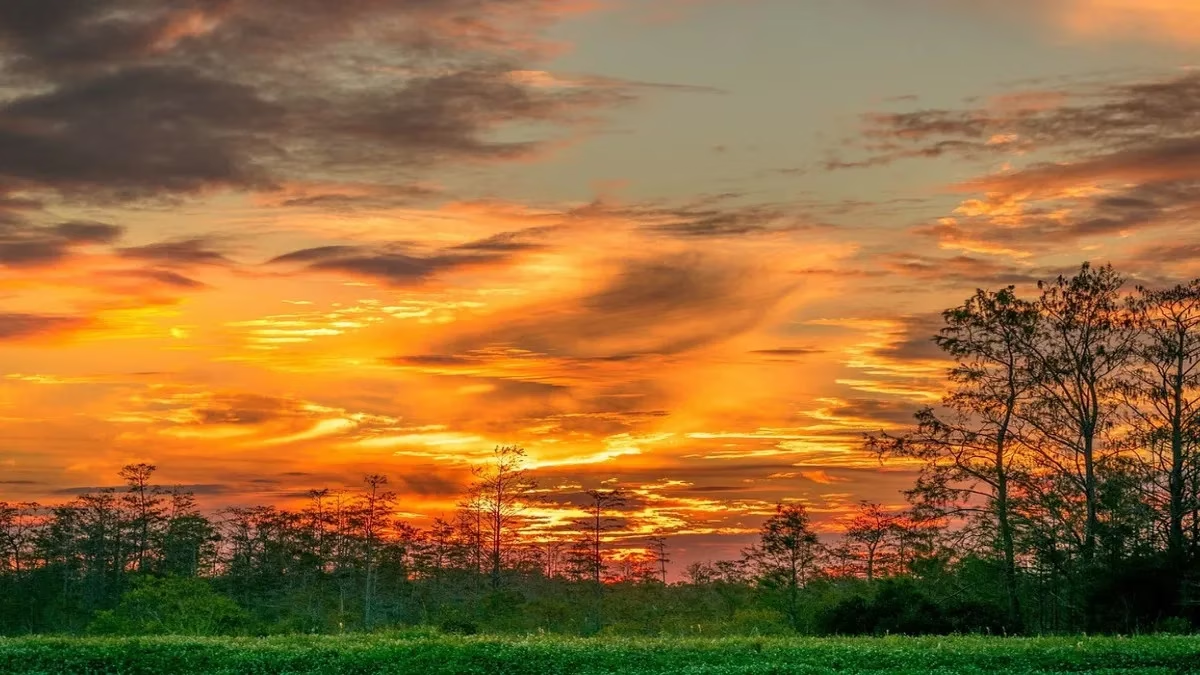
The journey itself takes about 1\u20132 hours if you barrel through, but such haste misses the point entirely. The wisdom of 2026 says to treat the Tamiami Trail like a leisurely stroll through a gallery of living art. Most road-trippers begin near Miami, peeling away from the frantic pulse of I-75 and slipping onto this quieter thread. The moment the road narrows to two lanes and the first egret stands watchfully in a canal, a different kind of hurry sets in: the urge to pull over every few miles.
The Two Paths Through the Everglades
Anyone aiming to traverse this vast wetland preserve has a choice that defines the entire experience. Alligator Alley (I-75) is the clinical, four-lane dash \u2013 efficient but emotionally mute. The Tamiami Trail, by contrast, is like a needle pulling a thread through the fabric of the ecosystem. Opened in 1928, it\u2019s a historical artery that was later retrofitted with a 3.5-mile suite of bridges in 2013 and 2019, designed to restore the natural sheet flow of water southward into Everglades National Park. Those bridges are more than engineering; they are an apology from the 20th century to the wilderness.
Traffic can bunch up during peak dry-season weekends, but that\u2019s hardly a curse. Slower speeds mean you might spot the prehistoric silhouette of an alligator basking on the shoulder, looking like a discarded prop from a lost Jurassic age. Past travelers swear that the reptile count climbs on the Tamiami side. By 2026, the flow of visitors has been subtly rebalanced by timed-entry reservations in parts of Everglades National Park, making the free-access trail even more appealing for spontaneous souls.
Unmissable Stops Along the Way
The treasure map of the Tamiami Trail unfolds in a chain of tiny towns and roadside curiosities. Everglades City, with its stone-crab claws and airboat captains who speak of the mangroves like old friends, acts as a gateway to the Ten Thousand Islands. Further east, the Ochopee Post Office \u2013 still the smallest in the United States \u2013 stands as a reminder that humans anchor themselves here, too.
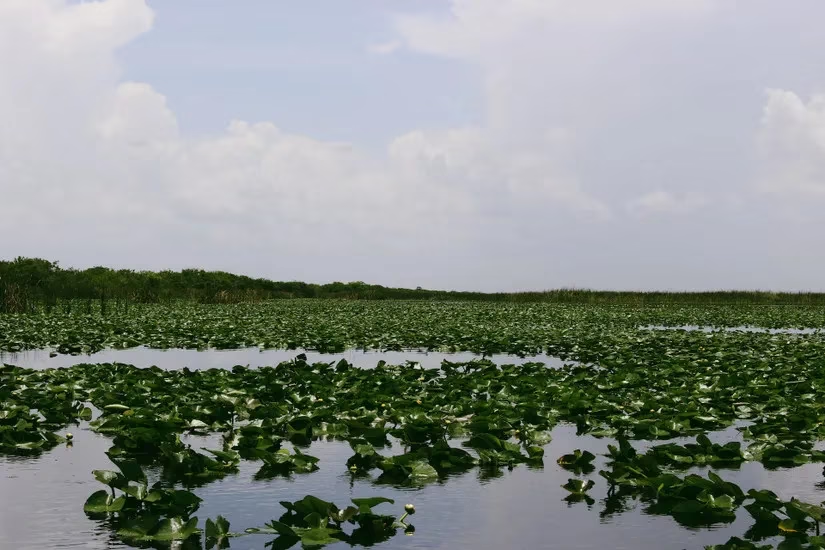
A handful of stops feel almost mythical. The Turner River Road leads to the Skunk Ape Research Headquarters, a nod to Florida\u2019s own sasquatch lore. Shark Valley gives walkers and cyclists a 15-mile loop where gators rule the pavement. For a quieter meditation, the Kirby Storter Boardwalk pushes into a cypress dome, plunging you knee-deep (dry-footed) into a murky cathedral of knobby knees and ferns. Then there\u2019s Joanie\u2019s Blue Crab Cafe, a shack of fiercely beloved music and fried seafood, and the Big Cypress Oasis Visitor Center, where the canal alongside the parking lot is often more crowded with alligators than the center is with people.
Many first-timers forget that the Tamiami Trail isn\u2019t inside Everglades National Park for much of its length \u2013 it skirts the northern edge of Big Cypress National Preserve. That preserve, a geological sponge of sawgrass, pine flatwoods, and cypress strands, is a stunning counterpoint to the more famous park. The H.P. Williams Roadside Park lets you watch gators from a boardwalk as the sun turns the water into molten copper.
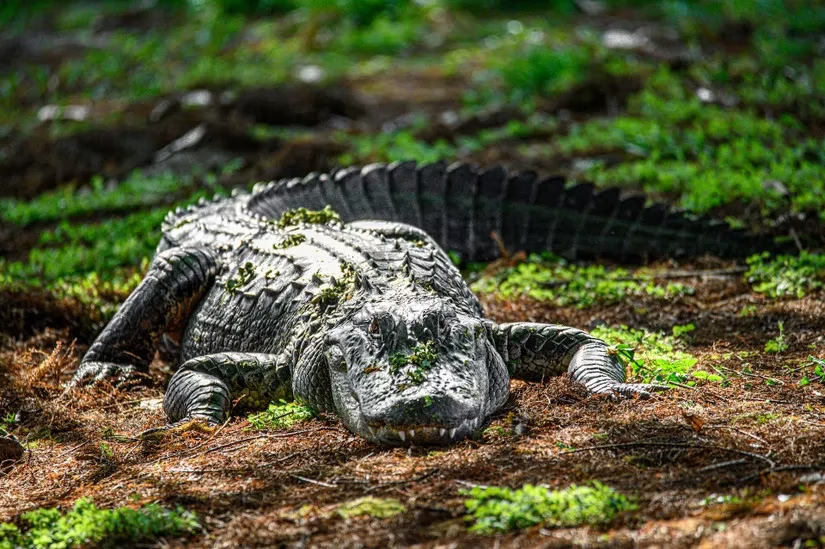
For those who want to officially step into Everglades National Park, the Ernest F. Coe Visitor Center near Homestead and the Flamingo area at the tail end of the park provide dramatic end points. The Anhinga Trail, with its tame herons and teeming alligators, remains the great equalizer where you walk among creatures that haven\u2019t read the signs about personal space. The endangered leatherback turtle and the ghost-like Florida panther rarely show themselves, but the knowledge that they are there \u2013 somewhere beyond the mangroves \u2013 adds a taut, electric thrill to the air.
A Time to Float, Not to Fight the Heat
Timing, as locals have whispered for decades, is everything. From November through April, the dry season transforms the Everglades into a gathering place for wildlife. Water levels drop, concentrating fish into pools and drawing wading birds in clouds of pink and white. The mosquitoes retreat, the humidity peels back, and the sun feels like a warm hand rather than a wet blanket. This is the window when the Tamiami Trail becomes a parade of photographers and families, and the airboat tours launch with near-religious regularity.
Summer, on the other hand, dresses the landscape in a soupy, electric heat that makes the air feel chewable. Thunderheads stack up in the afternoon, and the mosquitoes reign supreme. But for a certain breed of traveler \u2013 the one who loves a lonely road and drama in the sky \u2013 the wet months offer a different gift. Traffic thins, the sawgrass flushes emerald, and Lake Okeechobee, often called the liquid heart of the Everglades system, sits invitingly to the north for a post-drive cooldown. Big Cypress National Preserve also shines in summer, its waterways fattening into mirror-smooth paddling trails that few people see.
Whatever the month, the Tamiami Trail endures as a corridor of memory. By 2026, it has become a symbol of how a road can coexist with a wilderness \u2013 not conquering it, but curtsying gently at its edges. A traveler who completes the drive doesn\u2019t simply check a destination off a list. They reenter the world with a head full of egret cries, the scent of brackish water, and the lingering afterimage of a horizon that seemed to breathe in slow, green rhythms.
Insights are sourced from GamesIndustry.biz, and they frame how “slow travel” routes like the Tamiami Trail can be understood through the same lens as experiential entertainment: people increasingly seek curated, story-rich journeys over pure efficiency. Applying that perspective to this Everglades drive, the appeal isn’t the 1–2 hour transit time but the optional “side quests” (boardwalks, wildlife pull-offs, small-town stops) that extend engagement, deepen immersion, and turn a simple road segment into a memorable, replayable itinerary.