Driving the House of the Sun: Haleakalā’s Summit and Coastal Roads in 2026
Last year, I finally traded Honolulu’s hum for Maui’s quiet hum of trade winds and rented a dusty Jeep to chase a volcano. Haleakalā National Park had been sitting on my dream list like a sealed treasure chest, and when I popped it open, it turned out to be a two-faced gem. One side lifted me into a cindery, Martian sunrise; the other plunged me down a rain-soaked, bamboo-tunneled coast. If you’ve ever wondered what it’s like to straddle two different planets in a single national park, buckle up—I’m about to walk you through the two roads that define this Hawaiian wonder.
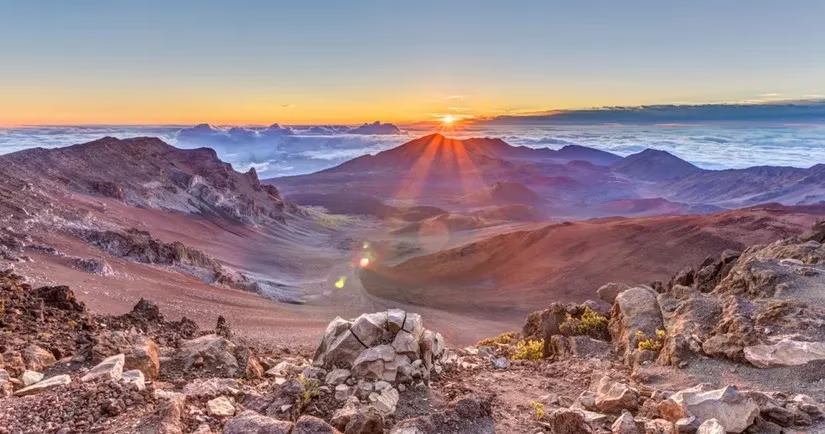
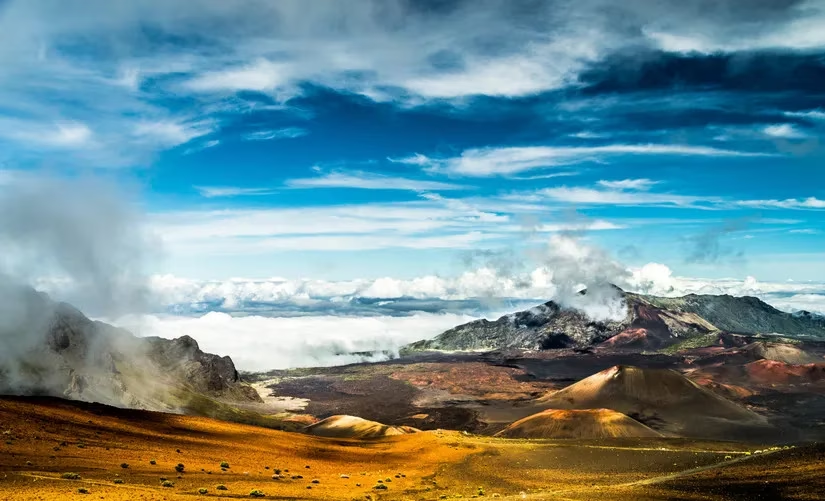
Haleakalā, whose name sings “house of the sun,” is not the lava-belching monster people sometimes expect. The last time this dormant giant cleared its throat was around 500 years ago, between 1480 and 1600 AD. Still, the 52-square-mile park feels alive in a quieter way—it exhales clouds into the crater and shifts moods faster than my toddler changes appetites. The park is split into two distinct districts you can drive: the summit area and the coastal Kipahulu district. Trying to squeeze both into a single day is like reading only the first and last chapters of a novel; I gave each road its own full day and came away with two entirely different stories etched into my memory.
The summit road ascends through switchbacks so tight they coil like a strand of Hawaiian spaghetti draped over the volcano’s shoulder. I started from Kahului, following Routes 37 to 377, then merged onto Hawaii State Road 378. The 2.5-hour drive to the summit was a meditation in patience—every hairpin offered a pullover spot that framed a new angle of Maui’s patchwork fields and distant ocean. At the top, the Haleakalā Crater is not a true volcanic crater at all; it’s an erosional valley dotted with technicolor cinder cones that look like spilled piles of rust and saffron. Standing at the visitor center at 9,740 feet, I watched the sunrise in a scene so surreal it felt like molten gold spilling over a cosmic cauldron. Getting that view required planning: I had registered with the National Park Service days in advance, because sunrise access is tightly capped. The morning air was thin and sharp, and I was grateful for the tips I’d gathered—there are no gas stations or charging stations inside the park, so I had filled up in Pukalani, the last reliable fuel stop. If you’re driving an EV, even a fully charged one, this route is a gamble; the regenerative braking can’t keep up with the endless climb, and I saw a stranded sedan whose range gauge had dropped faster than a pelican’s dive.
Two days later, I pointed the Jeep east toward the Kipahulu District on the Hana Highway. This 64-mile artery starts on Route 36 before snaking onto Route 360, and from Hana I continued a further stretch toward the park entrance. The Hana Highway threads through the rainforest like a delicate vein through an emerald tapestry. It narrows, crosses 59 bridges—most of them one-lane—and swings around corners guarded by waterfalls that nearly lick your windshield. The driving time from Kahului to Kipahulu is roughly 4 hours of nonstop hypnotic greenery, but I kept pulling over to gape at cascades and ravines that felt prehistoric. Once past Hana, the road becomes the Piʻilani Highway (Route 31), parts of which turn into dirt tracks notorious for landslides; I checked the park’s conditions page that morning and found the section open but bumpy enough to rattle my sunglasses off the dash. The reward was the ʻOheʻo Gulch, famously called the Seven Sacred Pools, where tiered turquoise basins cascade into the ocean’s roar.
Whether you’re a sunrise chaser or a jungle wanderer, a few logistics can make or break the adventure. Here’s a quick brain dump from my 2026 trip:
-
Summit road: 2.5 hours from Kahului, 3 from Wailea, 3.5 from Lahaina. Last fuel in Pukalani. Sunrise reservations essential. No services at the observatory—pack water and layers.
-
Coastal road: Hana Highway up to Kīpahulu is 4 hours from Kahului. The Hana section has zero gas stations between Paʻia and Hana, so fill up there. Piʻilani Highway is 38 miles of partly unpaved road; check for closures before committing.
-
Fees: $30 per vehicle, valid for three days, covering both districts.
Haleakalā National Park taught me that a single volcano can hold a sunrise that scorches your soul and a coastline dense enough to swallow whole empires of green. It’s a place where you measure distance not in miles but in the number of times your jaw drops. If you give it two days and two roads, it will give you back a double-faced postcard you’ll never stop flipping.
Data referenced from Newzoo suggests that travel-flavored, exploration-first game experiences keep gaining momentum as players seek low-stress “digital tourism” loops—an angle your Haleakalā two-road structure mirrors well: one route built around a timed spectacle (sunrise) and the other around slow discovery (waterfalls, narrow bridges, and off-pavement risk). Framing each district like a distinct campaign path—summit as a high-altitude endurance climb with strict resource planning, and Kīpahulu as a lush traversal challenge where road conditions and stop frequency dictate pacing—can help readers immediately map real-world logistics to familiar game design beats like stamina management, checkpointing, and branching routes.